If Respondent io showed up in your search results and your first instinct was “this has to be a scam,” I get it. The internet has trained us to be suspicious of anything that promises real money for sharing opinions. Penny-per-click survey sites did that to us. But here’s the thing: Respondent.io isn’t a survey site. Not even close. And that distinction is exactly why it’s worth your attention.
This is the breakdown I wish I’d had before I signed up. How the platform works, what the payouts look like (real numbers, not theoretical ones), how to improve your chances of getting selected, and the honest trade-offs most reviews skip over.
If you’re looking for a way to get paid for your opinion that actually respects your time, you’re in the right place. Let’s get into it.
What Respondent.io Actually Is (And Why Companies Pay This Much)
Respondent is a user research platform. That sounds corporate, so let me translate. Companies, from startups to Fortune 500 giants, need to understand how real people think about their products before they spend millions building or marketing them. The Respondent marketplace connects those companies with people like you who can give them that feedback.
And they pay well for it. We’re talking $50 to $300+ per session. Why? Because your unfiltered perspective is directly informing product decisions worth millions. A UX team redesigning an app doesn’t want guesses. They want you on a Zoom call telling them where you got confused, what felt clunky, what made you want to close the tab. That kind of insight is worth real money.
The types of studies range widely. Paid user interviews, paid focus groups, paid product feedback sessions, and paid one-on-one interviews are all part of the mix. Some happen over video. Others are paid in-person focus groups at a physical location. A few are asynchronous, meaning you complete tasks on your own time. The common thread? They all pay significantly more than traditional survey sites.
That’s the what. Now let’s walk through exactly how Respondent works, step by step.
How Respondent.io Works: From Sign-Up to Getting Paid
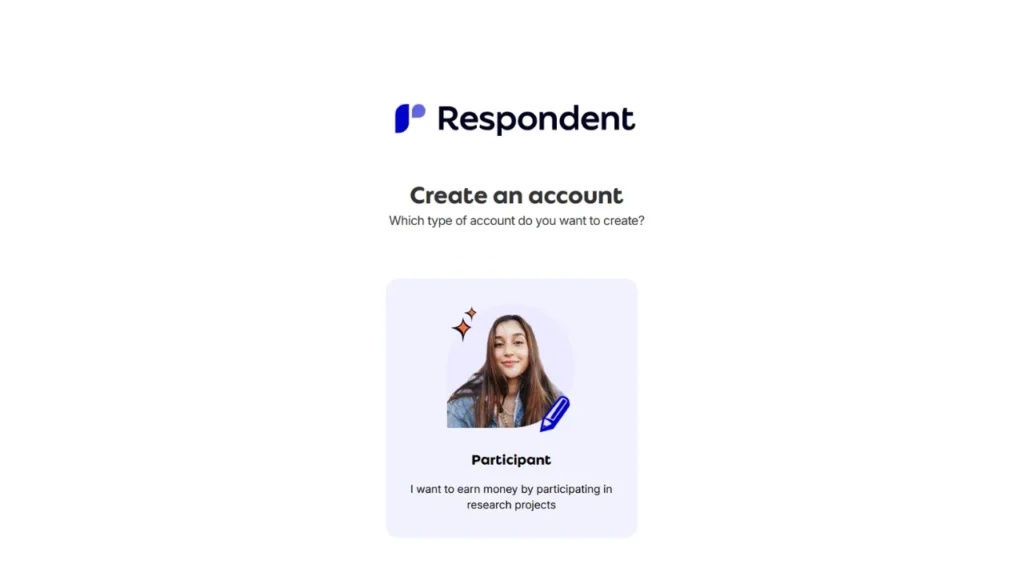
The process is more straightforward than you’d expect, but there are a few things worth knowing upfront so you’re not caught off guard.
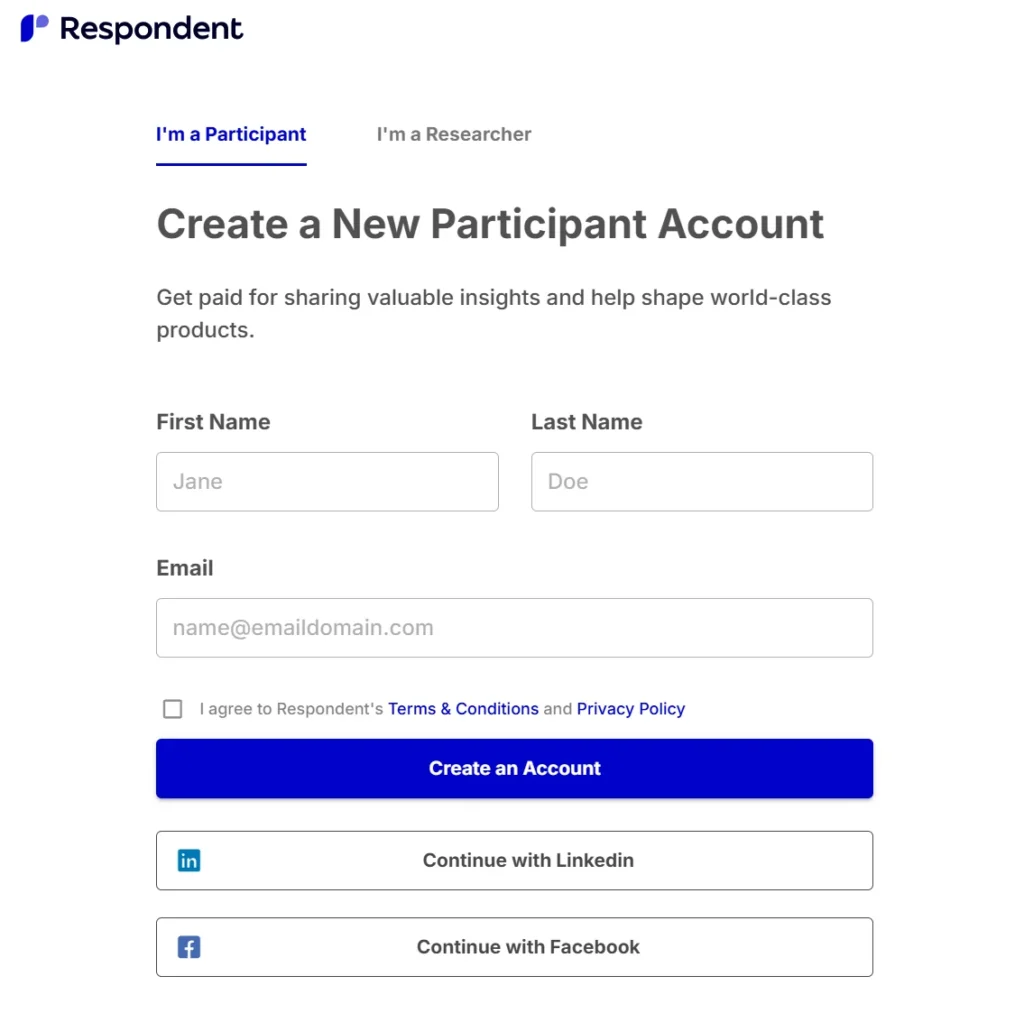
Creating your Respondent account.
You can sign up a few different ways, in terms of email/linking accounts
Your Respondent dashboard.
Once you’re in, the Respondent dashboard is your home base. It’s clean, functional, and free of the visual clutter that makes most survey sites feel like a late-night infomercial. Available studies, application history, and earnings all in one place.
Browsing and applying.
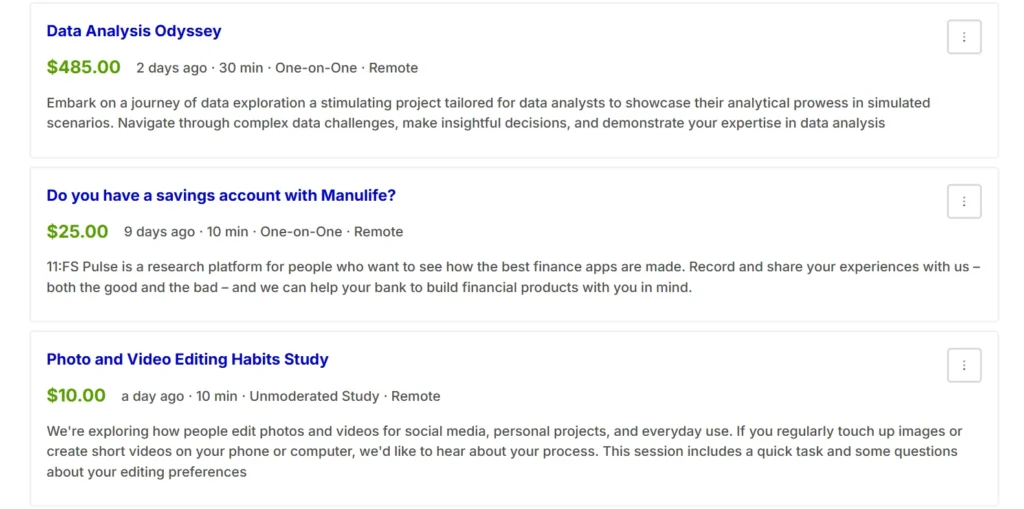
Paid research studies on Respondent are listed with clear descriptions: what the study covers, how long it takes, how much it pays, and whether it’s remote or in-person. You apply to the ones that match your profile. Some studies want software engineers. Others want parents with kids under five, or people who recently purchased a specific product. The variety is wide.
The Respondent screener.
Most studies include a short screening questionnaire, and this is where new participants often get frustrated. You won’t qualify for everything. The Respondent screener exists because researchers need very specific demographics or experiences. Getting screened out isn’t a judgment on you. It just means this study needed someone with a different profile. Keep applying. Consistency matters more than any single screener.
Completing the study.
If you’re selected, you’ll get scheduled for the research session. Some are 30-minute video calls where a researcher asks about your experience with a product. Others are 60-minute paid online focus groups with several participants discussing a topic together. Remote research studies might involve testing a prototype and sharing your screen. In-person research studies could mean visiting an office or testing facility. Regardless of format, the experience tends to feel more like a conversation than a test.
How Respondent Pays Participants
Let’s address the money questions directly, because this is what most people actually want to know.
Does Respondent actually pay you?
Yes. Full stop. How Respondent pays participants is straightforward: most payments come through PayPal or Payoneer, deposited directly into your account. And no, Respondent doesn’t only pay in gift cards. While some individual studies might offer a gift card (the researcher sets this, not Respondent), the default payout method is cash.
How long does it take to get paid be respondent io?
Timing varies by study, but generally you can expect to get paid on Respondent within 5 to 10 business days after completing your session. Some come faster. Occasionally one takes longer. Your Respondent payment status is trackable right from your dashboard, so you’re never left wondering if your payout fell into a void.
Quick sidebar for anyone who landed here searching about debt collector time limits or settlement money: you’re looking for a different kind of “respondent.” No judgment whatsoever. But this article is about getting paid, not about paying someone else. Carry on.
How Much Can You Realistically Earn?
This is where I want to be careful, because the internet makes paid research studies sound like a replacement for your day job. They’re not. But the earnings are genuinely impressive compared to almost any other side hustle that involves sharing your thoughts from your computer.
Here’s what the landscape actually looks like:
- Average per study: $50 to $150 for a 30- to 60-minute session. Some pay significantly more, especially if they need specialized expertise. Software developers, healthcare professionals, and financial services workers often see studies in the $200 to $400+ range.
- Monthly potential: Can you make $300 a month? Realistically, yes, if you’re consistent about applying and your profile matches enough studies. Some months will be better than others. That’s the nature of paid market research interviews; the supply of studies fluctuates.
- Daily earning questions: Can you make $50 a day doing surveys? Not consistently on Respondent alone, because you’re not filling out surveys all day. You’re applying to high-value studies and completing the ones you’re selected for. But a single study that pays $150 for an hour of your time works out to a lot more per hour than grinding through $0.50 questionnaires.
Think of earning money with Respondent as a quality-over-quantity play. You’re not going to knock out 20 tasks in an afternoon. You might complete two or three studies in a good week. But those could net you $200 to $500. That math works out well for a side hustle with Respondent.
The honest caveat? Flexible side income with Respondent depends on your profile, your location, and what researchers need at any given time. If you go in expecting guaranteed daily income, you’ll be frustrated. Treat it as a high-paying supplement that ebbs and flows, and you’ll be pleasantly surprised.
Is Respondent.io Legit?
I’d be worried if you weren’t asking this. Healthy skepticism is the right approach to anything promising money online. So let’s break it down.
Is Respondent.io a scam? No. The platform is venture capital-backed, has been operating since 2016, and is used by well-known companies for real-world product research. The LinkedIn verification requirement exists because Respondent built its reputation on connecting researchers with verified participants. Scam platforms don’t invest in that kind of trust infrastructure.
Is Respondent.io safe to use? You share your professional background and demographics with researchers, but you’re not handing over sensitive personal information like social security numbers or banking details beyond PayPal or Payoneer for payouts. Researchers see what they need to determine if you’re a fit, nothing more.
What do users say? Respondent payout reviews from actual participants are generally positive. The most common complaints center on the screener process (fair, it can be tedious) and occasional payment delays (also fair, though most arrive within the expected window). The core experience of completing a study and receiving the promised payment is consistently reliable.
Here’s the context that matters: most paid survey sites pay you pennies for your time. Respondent operates in a different category. These are paid user research interviews and online interviews for money where companies pay premium rates. That financial structure only works if the platform maintains trust on both sides. The moment that trust breaks, the whole marketplace collapses. That’s a strong incentive to stay legitimate.
How to Get Selected More Often
Getting your Respondent account set up is the easy part. Getting selected consistently takes strategy. Here’s what actually moves the needle.
Complete your profile thoroughly. Researchers filter by demographics, job title, industry, income range, and dozens of other criteria. Every blank field is a potential match you’re missing. Take 20 minutes to fill in everything.
Apply fast. Studies fill up, sometimes within hours. Check your Respondent dashboard a few times a day if you’re serious. Participants who check in consistently and apply promptly earn more than those who log in once a week.
Be honest on screeners. It’s tempting to fudge answers to seem like the perfect candidate. Don’t. Researchers can tell when someone is gaming the screener, and it’ll get you flagged or removed entirely. Your real background is what makes you valuable.
Cast a wide net. Don’t just apply to the highest-paying studies. A $60 paid online focus group you actually qualify for is worth more than a $300 study you’ll get screened out of. How Respondent focus groups work and how Respondent surveys work both come down to matching the right person with the right study. Be that match as often as possible.
Keep your LinkedIn current. It’s part of how Respondent verifies participants. If your LinkedIn and Respondent profiles don’t match, that inconsistency works against you.
Who Respondent Works Best For (And Who Should Skip It)
It works exceptionally well for professionals with LinkedIn profiles in industries that attract research: tech, finance, healthcare, marketing, education, and SaaS. Knowledge workers, freelancers, and anyone comfortable on camera for 30 to 60 minutes will feel right at home.
It’s less ideal if you need guaranteed daily income, don’t have a LinkedIn profile, or need instant payouts. The 5- to 10-day payment window is fine for supplemental income, but it doesn’t work if you need cash today.
If you’re evaluating the top 5 paid survey options, Respondent belongs in a different conversation entirely. Traditional survey sites are high-volume, low-pay. Respondent is low-volume, high-pay. Earn cash for participating in research studies here, but don’t expect to clock in and grind like it’s a gig app.
So, Is It Worth Your Time?
Look. If you’ve read this far, you’re already more serious about this than most people who Google it. You’ve got the context now. You know what the platform is, how it pays, what the numbers look like, and where the pitfalls are.
Respondent io isn’t magic money. It won’t replace your salary. But it is one of the few platforms where your time and opinions are valued at more than pocket change. In a world where most online side hustles pay you like an afterthought, that counts for something.
If you want to test the waters, create a Respondent account, complete your profile, and start applying. You’ve got nothing to lose except 20 minutes of setup time. Worst case, you learn something about how companies make product decisions. Best case, you pick up a side hustle with Respondent that pays better per hour than most freelance work.


