Sometimes it takes effort to make your house smell fresh and match the summer vibe you want. I found this out two summers ago in a rental with a basement that always smelled like a wet bag of sweaty gym clothing, no matter what I tried. I used bergamot, eucalyptus, even a $40 candle that promised “crisp ocean air.” Nothing made the basement air livable. The smell always returned within an hour, often even stronger, almost as if the room was offended by my efforts to make it smell better.
Here’s what was really going on, and it might be happening in your home too when the weather gets warm: summer humidity gives mould, mildew, and odour-causing bacteria the perfect conditions to grow.
Warm, damp air settles in carpets, closets, and anywhere with poor airflow. If you spray something floral on top of that, you end up with a humid room that smells like a candle shop and farts. It doesn’t smell better—just different, and often worse.
If you want your house to smell fresh in summer, you need to do two things.
First, find and get rid of whatever is causing the smell.
Second, add a scent that fits the season—something sharp and green, not the heavy, sweet fragrances that work in winter but feel too much in July.
I’ll share the products I’d buy again, the ones I wouldn’t, and some easy DIY options if you don’t want to spend any money.
Why Does My House Smell Musty in Summer?
A musty smell in summer usually happens because warm air holds more moisture than cold air, and that extra water has to settle somewhere. It collects on cooler surfaces like basement walls, the backs of closets, or under windowsills, where it condenses. Mould and mildew feed on this moisture and release the sour, earthy smell you notice. It’s not just in your head, and it’s not just a smell problem—it’s really a moisture problem that you notice through your nose.
In homes that go through different seasons, the usual problems are spaces that collect moisture but never fully dry, poor ventilation, dirty laundry and linens, rugs that soak up humidity, and HVAC systems that keep recirculating stale air. Cooking smells and pet odours also get worse because warm air spreads odours more quickly than cold air. These smells usually get stronger as the temperature rises.
The solution isn’t a stronger air freshener. You need to remove the moisture first, so the room can actually smell fresh instead of just mixing in more unpleasant scents.
Fix the Source Before You Touch a Single Bottle of Fragrance

Skipping this step is the main reason attempts to make a house smell fresh often fail. Spraying citrus over a humidity problem is like putting perfume on a wet, smelly towel. It smells okay for a few minutes, but the bad smell always comes back because the towel is still wet.
A dehumidifier set to around 45 to 50 percent humidity will noticeably cut musty smell within a few days in the rooms that need it most: basements, bathrooms, laundry rooms, anywhere airflow is poor. You don’t need an industrial unit. A 30 to 50 pint model handles a single room in most houses, and that’s the entire ask.
Open windows on dry days, not humid ones. This might seem obvious, but it’s easy to forget when it’s hot outside, and you’re hoping for fresh air. Always check the humidity, not just the temperature. Early mornings, before the humidity rises, are usually the best time to air out your home.
Clean or replace your HVAC filter too. A dusty filter not only blocks airflow, but also recirculates whatever is trapped in it every time the system runs. If you can’t remember the last time you changed it, that’s a good reason to do it now.
Let the bathroom exhaust fan run longer than you think is needed. Fifteen minutes after a shower isn’t enough when it’s humid. Moisture can stay in the bathroom for an hour or more in sticky weather, and that lingering dampness feeds mildew along grout lines and shower curtains—the kind you might not notice until you look closely.
Wash any fabric that might be holding onto smells—curtains, throw pillows, bath mats, and area rugs. These items trap humidity and odours much more than hard surfaces do. If you’ve cleaned everything else and the room still smells, the fabric is probably the culprit.
Once you’ve dealt with the moisture, fragrance can finally do what it’s meant to—add a finishing touch to a clean room, not just cover up dampness.
How to Use Fresh Flowers to Scent a Room Naturally
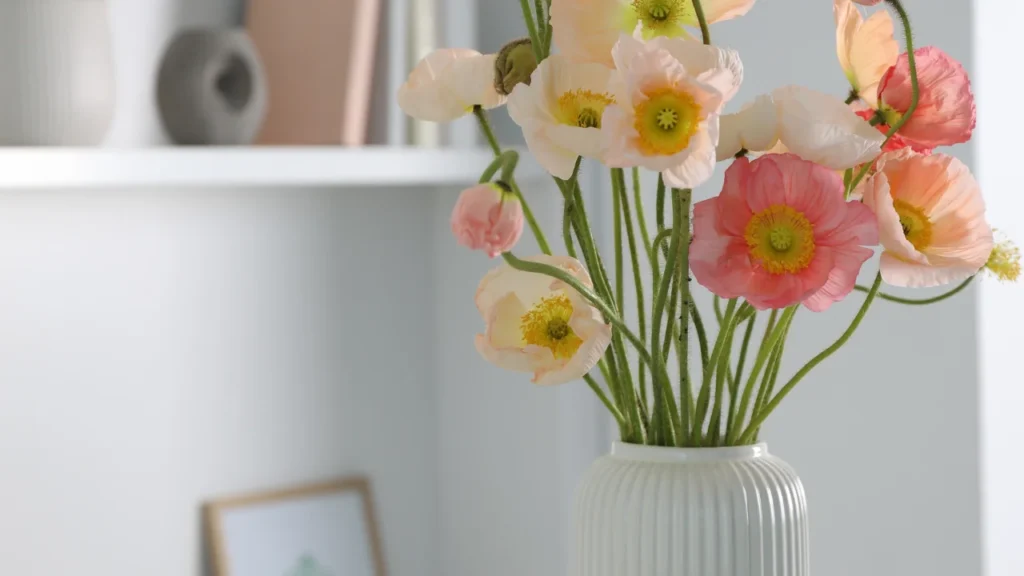
Flowers offer something candles and sprays can’t. Their scent changes throughout the day instead of repeating the same note. Peonies, for example, smell different in the morning than they do in the evening, and that natural change feels more alive than any synthetic fragrance, no matter what the label says.
Lavender, jasmine, and gardenia have strong scents that work well in a living room or entryway. Eucalyptus stems, which you can find at most grocery stores, give off a clean, almost medicinal green smell when you crush a leaf. They last for weeks without water because the stems are hardy enough to air-dry. Place them near an air vent or anywhere with some airflow—a vase in a still room won’t spread the scent.
There is a limitation, though: fresh flowers provide a light scent and can’t replace actually fixing an odor problem. They’re a finishing touch, like a candle or diffuser, and their scent fades in a few days. If you use them to cover up a musty smell instead of adding them to a clean room, you’ll just keep buying more flowers and still notice the mildew underneath. To make them effective, you need to get rid of the odour problem first.
How to Scent a Room Without Heat
Many people think candles are the only real way to add fragrance at home. But heat changes how a scent works, and in summer, that can be a problem. Burning a candle adds more warmth to an already hot room, releases fragrance quickly, and then it fades just as fast. If you want a more consistent scent, it’s worth looking at passive options.
Passive reed diffusers use scented oils that travel up the reeds and slowly release fragrance into the air, with no heat or flame needed. They don’t need power, there’s nothing to watch out for around pets or kids, and the scent stays steady for weeks instead of fading quickly. They’re also very low-maintenance—just fill the container and flip the reeds once a week.
Smart plug-in diffusers, like the Pura system on Amazon, are a middle ground between reed diffusers and candles. They use a little heat to spread fragrance, but you can control the strength and timing with an app, so you’re not wasting scent when you’re not home. The downside is that you’ll need to replace the fragrance vial every few weeks, which costs more over time than a reed diffuser.
Fragrance sachets work well in places a diffuser can’t reach, like closets, sock drawers, or linen cabinets. They don’t need a flame or a plug, and you only need to replace them every couple of months when the scent fades.
If you really love candles and don’t want to stop using them in summer, that’s fine. Just choose lighter options. Candles made from 100 percent soy or coconut wax burn cooler than paraffin, which makes a difference in July.
Light Summer Scented Candles and Sprays To Keep Your Home Fresh
A vanilla-bourbon candle that feels cozy in January can smell too heavy in July, and humidity makes it worse. For summer, choose scents that are light, green, or citrusy—not warm, sweet, or anything that reminds you of winter.
For a Mediterranean summer scent, Chesapeake Bay Candle’s Refresh and Rejuvenate in Mediterranean Citrus leans on mandarin, pink grapefruit, and bergamot up top, with cedar and white musk underneath to keep it from smelling like bathroom cleaner. It’s a soy blend, so it burns cooler than a straight paraffin jar, and the throw is strong enough for an open-concept kitchen and living space without overwhelming anything smaller, like a bedroom.
For a citrus and bergamot room spray, Mrs. Meyer’s Clean Day is one of the more natural room fragrance sprays sold on Amazon, thanks to its use of essential oils rather than a heavy synthetic fragrance base. The Basil scent, in particular, reads green and herbal, closer to a crushed leaf than anything from a perfume counter. It’s non-aerosol too, which matters if you’re spraying near anyone with asthma, and one 8-ounce bottle lasts months at normal use.
The tomato leaf home fragrance trend is worth mentioning, even if it sounds odd at first.
Tomato leaf has a sharp, green scent that’s more like a garden than a tomato. It smells genuinely fresh, not floral, which is the idea. Mrs. Meyer’s makes a Tomato Vine spray that captures this note without actually smelling like a tomato. I was skeptical until I tried it on a friend’s recommendation, and now I keep a bottle by the back door because that’s where I like it most.
Linen sprays for summer are different from room sprays and should be kept separate. Linen sprays are safe for fabrics and lighter, meant for use on bedding or pillows instead of filling a whole room. A lavender linen mist on your pillowcase can help more on a hot, restless night than spraying lavender into the air.
How to Use Air Purifiers for Odour Control, Not Just Allergies
Most people buy air purifiers for allergies, but they also help reduce odours. A HEPA filter traps dust, pollen, and pet hair. An activated carbon filter, which is often included with the HEPA filter, actually absorbs odour molecules from the air rather than just catching particles.
This difference matters because many budget air purifiers skip the carbon filter or use a thin carbon foam that stops working after a few weeks. If you want to control odours, look for a unit that specifically lists an activated carbon filter, not just the word “HEPA” on the box.
Levoit’s Core series is a good, widely available option on Amazon. The Core 300 and Core P350 models use a 3-in-1 filter with a real carbon layer and are designed for single rooms, which is what most apartments and bedrooms need. Use one in the room that smells the worst—like a basement, pet area, or kitchen—and give it a few days to work. Odour absorption takes time and works best after you’ve cleaned and want to remove any leftover smells.
An air purifier removes odour molecules from the air, but it won’t fix a wet carpet or a mouldy windowsill. It’s meant for ongoing air quality, not for solving moisture problems you haven’t addressed. Use it along with a dehumidifier, not as a replacement.
DIY Odour Control If You’d Rather Not Spend a Cent
If you want a fresh scent quickly without buying anything, try a stovetop simmer pot. Use lemon slices, a few sprigs of fresh mint, cinnamon, and clove buds with two cups of water on low heat. It uses what you already have at home and scents your kitchen and nearby rooms faster than most plug-ins.
For closets and drawers, use a small sachet of dried lavender or put a few drops of citrus essential oil on a cotton ball and tuck it into a corner. This works almost as well as store-bought options, and you can refresh it for free every few weeks. My grandmother used dried lemon peels on a windowsill, and her linen closet always smelled better than mine does with a $30 diffuser.
Neither of these tricks replaces fixing a real moisture problem. They’re just free ways to add a finishing touch, like a candle or diffuser, once you’ve dealt with the main smell—not a shortcut for skipping that step.
Get the Order Right and the Odour Will Stay Away
The order you do things matters most. To make your house smell fresh like summer, control moisture and ventilation first, then add fragrance—choose summer scents like citrus, green, herbal, or light floral, not the heavy, sweet ones for winter. If you do it the other way around, you’re just covering up a problem that will keep coming back, just like it did in my basement two summers ago.
Start with the room that smells the worst. Use a dehumidifier or open the windows on the next dry morning. Then pick a scent that fits that room. For a basement, use an air purifier with real activated carbon, not a candle. For a bedroom, use a linen spray and a passive reed diffuser, not anything that uses heat. Choose the right solution for each room, and the fresh smell will last for weeks instead of just twenty minutes.


